Critical infrastructure monitoring systems are increasingly targeted by cyber threats. PLC Group’s RMS platform implements security-by-design with VPN-encrypted communications, certificate-based authentication, network segmentation, and comprehensive audit logging.
Multi-factor authentication, role-based access control (RBAC), SIEM integration, automated security patch management, and OT/IT network separation.
An advanced security monitoring system integrates access control, video surveillance, intrusion detection, and environmental monitoring into a single unified interface. This multi-layered structure strengthens situational awareness while reducing the complexity of managing disparate systems across remote, urban, and high-risk sites.

PLC Group’s platform integrates a robust security automation system that streamlines protection across all assets. Automated workflows correlate alarms, validate events, trigger escalations, and enforce standardized response actions. This reduces manual intervention, accelerates response speed, and enforces consistent security governance across mission-critical operations.
For distributed networks and unmanned facilities, a remote security monitoring system enables continuous oversight without requiring on-site personnel. Operators gain real-time access to alarms, video feeds, environmental telemetry, and equipment health metrics from a centralized command center or secure cloud-based interface. This approach supports proactive threat detection and rapid decision-making for geographically dispersed sites.
Secure entry governance requires precise authorization workflows, role-based access policies and continuous oversight. The platform integrates with leading access control technologies to manage permissions, track entry attempts, enforce compliance policies, and maintain regulated access across multi-site environments. Credential audits and automated rule enforcement support stronger accountability and regulatory compliance.
Predictive algorithms analyze multi-source telemetry to detect unusual patterns, equipment anomalies, and potential breaches. Automated rules accelerate response times by correlating alarms, prioritizing notifications, and initiating intelligent escalation workflows. This ensures faster mitigation and reduces security-related downtime across critical operations.
1. Centralized Multi-Site Control
Unified visibility across all facilities reduces operational complexity and ensures consistent protection standards.
2. Proactive Incident Prevention
Real-time monitoring, AI-driven alerts, and automated responses help detect threats before they escalate.
3. Reduced Operational Costs
Remote security monitoring minimizes on-site staffing needs and significantly reduces manual intervention.
4. Enhanced Compliance and Audit Readiness
Standardized access governance and automated event logs support regulatory and internal compliance requirements.
5. Faster Response and Issue Resolution
Automated workflows, prioritized alerts, and integrated video intelligence shorten reaction times during critical events.
6. Improved Uptime for Critical Infrastructure
Environmental monitoring, intrusion detection, and automated rules prevent disruptions and protect core infrastructure assets.
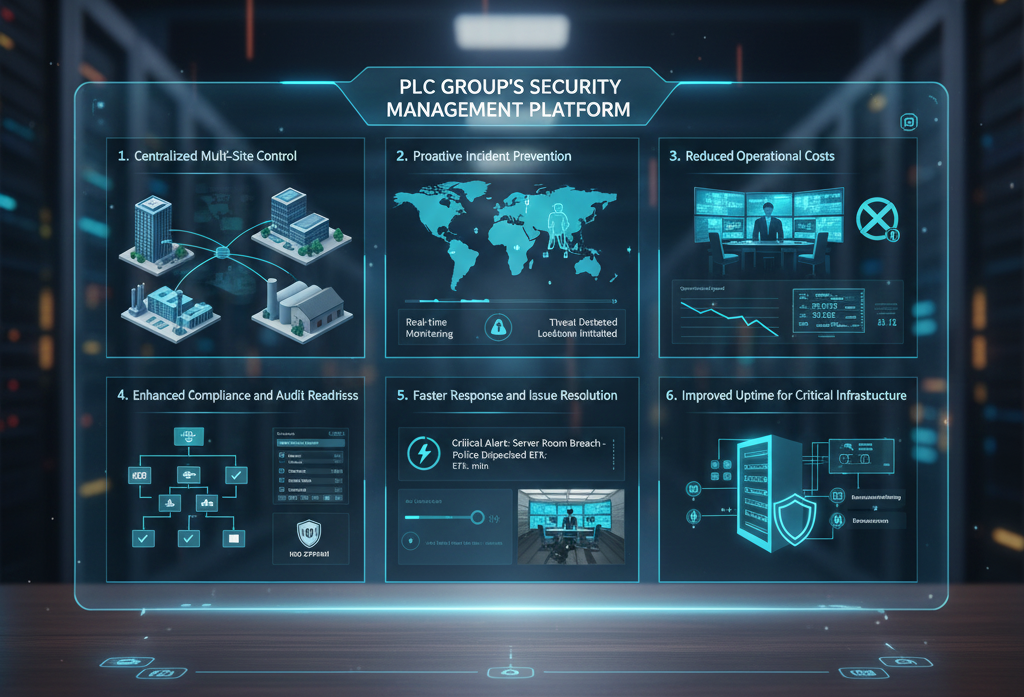
PLC Group’s Security Management platform delivers unified control, advanced monitoring, and automated intelligence for mission-critical facilities. With centralized visibility, multi-layered protection, remote monitoring capabilities, and AI-driven insights, organizations gain stronger compliance and operational resilience across single-site or multi-site deployments.
Connect with PLC Group today to deploy a security framework designed for continuous protection and intelligent decision-making.

VPN-encrypted communications, certificate-based authentication, role-based access control, comprehensive audit logging, network segmentation, and SIEM integration—all included by default.
All RMC controllers connect to AxIn platform via VPN tunnels with certificate-based authentication. No inbound firewall rules required at site level, eliminating common attack vectors.
Yes. Framework supports NERC-CIP requirements including access control (CIP-005), audit logging (CIP-007), personnel training (CIP-004), and configuration management (CIP-010). Automated reporting reduces compliance burden.
Yes. AxIn platform exports security events to enterprise SIEM systems (Splunk, QRadar, ArcSight) via syslog or API, enabling unified security monitoring across IT and OT environments.
TAC operations deploy security patches during scheduled maintenance windows. RMC controllers can auto-update or require approval depending on customer policy. Critical security updates expedited within 48 hours.
Framework reference: "Legacy monitoring systems lack modern security controls." Average cost of OT cyber incident: $1M-5M (downtime, recovery, regulatory fines). PLC's security framework typically 5-10% of total RMS deployment cost—far less than incident response.