Modern critical infrastructure requires physical devices that can sense, control, and communicate with precision. PLC Group provides a complete hardware ecosystem designed to monitor, automate, and secure operational environments across telecom towers, data centers, edge sites, utilities, and cable landing stations.
Our hardware products form the foundation of reliable remote monitoring and control. Gateways, controllers, sensors, and energy meters work together to provide continuous visibility, environmental stability, energy optimization, and fast response across mission-critical operations. These systems support applications for HVAC Monitoring Systems, Remote monitoring hardware solutions, and HVAC Remote Monitoring, while keeping the focus on hardware-driven capabilities.
Why Hardware Is the Core of Remote Monitoring and Control
Remote visibility only works when the underlying hardware is designed for accuracy, durability, and interoperability. PLC Group’s portfolio enables:
- Accurate sensing of environmental, power, and mechanical parameters
- Secure data acquisition through Modbus, SNMP, MQTT, CANBUS, and dry contacts
- Local equipment control for HVAC units, power systems, DG sets, batteries, and site infrastructure
- Interoperability with both intelligent and legacy equipment
- Edge-level logic that improves decision-making and reduces network dependency
This hardware-first approach helps operators maintain optimized and reliable facilities even in remote or unmanned environments.
Hardware Categories for Remote Monitoring and Control
1. Gateways
PLC Group gateways serve as the primary communication bridge between field equipment and the RMC platform. They gather telemetry, execute commands, and ensure secure site-to-cloud communication.
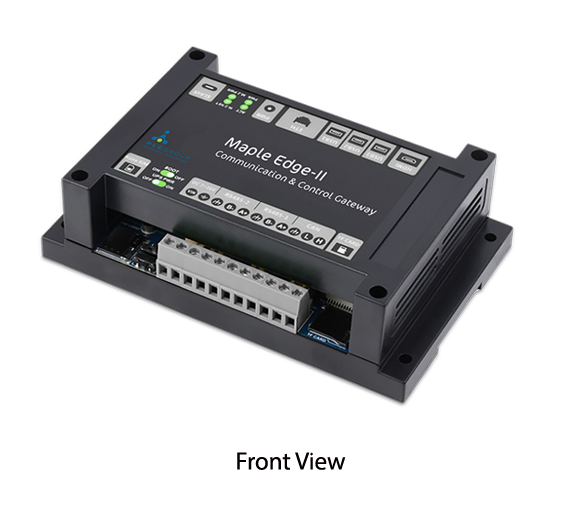
Maple Edge-II
A compact and rugged edge gateway engineered for distributed sites and micro-installations.
Key capabilities include:
- Multi-protocol communication
- Local processing for quick response
- Secure cloud connectivity
- Suitable for telecom shelters and remote enclosures
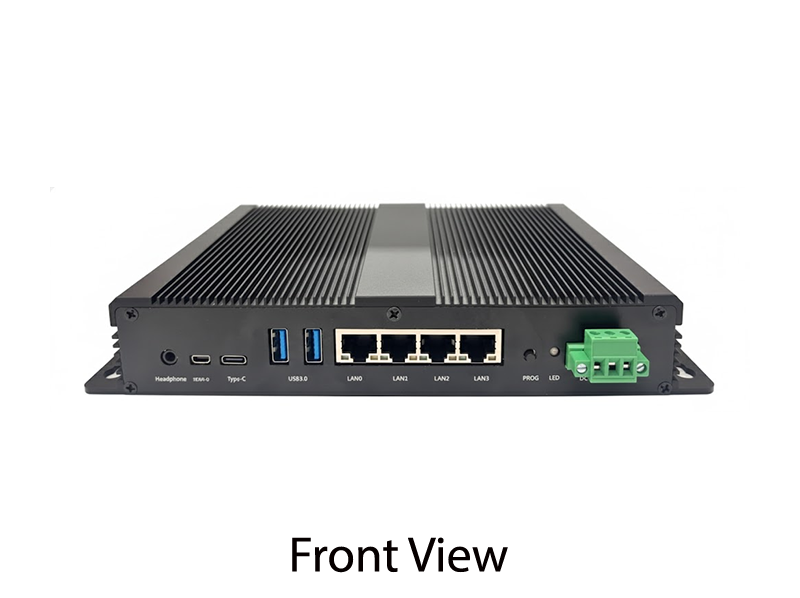
Maple Edge-III
A high-performance gateway designed for extensive or multi-equipment facilities.
Key capabilities include:
- Higher input and output capacity
- Enhanced processing power
- Local data storage and event logging
- Ideal for data centers and utility facilities
Both gateways provide the hardware backbone required for stable, secure remote monitoring applications.
2. Controllers
PLC Group controllers manage equipment behavior, automate cooling sequences, regulate environmental stability, and deliver precise command control for critical infrastructure.
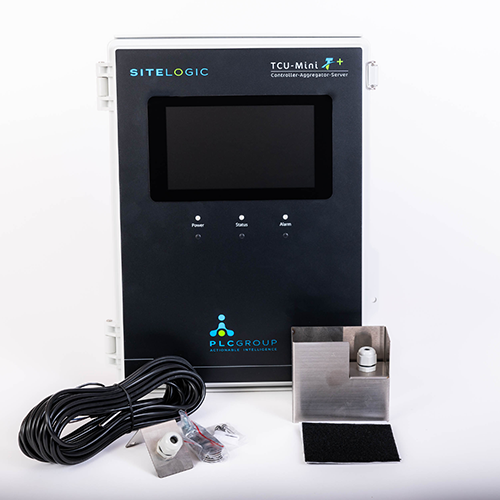
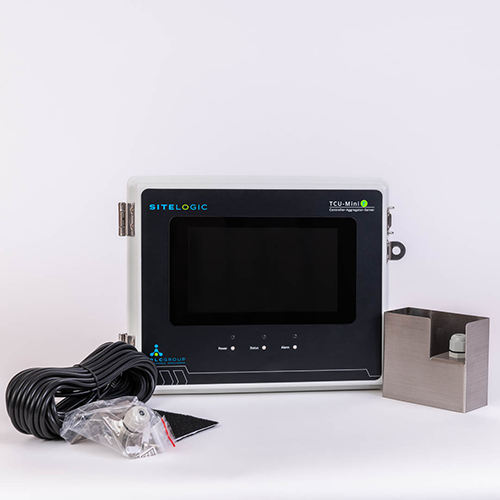
TCU-MiniT+
A compact controller built for smaller environments and smaller HVAC units.
- Manages temperature, humidity, and airflow
- Supports programmed control sequences
- Designed for single or low-density cooling systems
TCU-800 Micro
An advanced controller for telecom, edge, and small data environments.
- Multi-vendor HVAC control
- Predictive operation logic
- On-site alarms and flexible input and output options
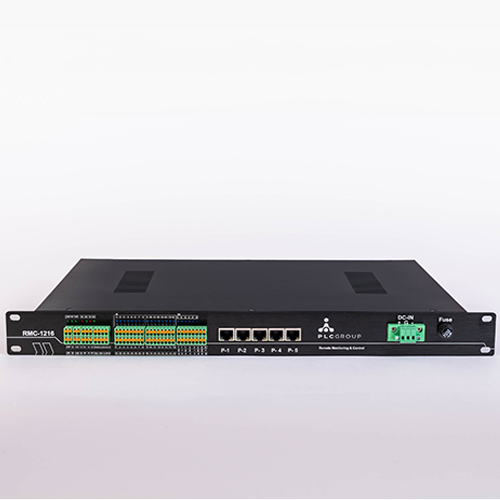
RMC-1216
A universal controller designed for high-density operations.
- Supports environmental sensors, energy inputs, and external systems
- Remote configuration and firmware updates
- Suitable for complex site automation requirements
These controllers form the control layer for cooling optimization, energy management, and site operations.

TCU-NG2
PLC Group’s flagship controller, gateway, and aggregator for telecom sites, cable landing stations, and edge data centers.
- Real-time monitoring and control of HVAC (single or dual, with lead-lag logic across smart and legacy units)
- Remote monitoring and control of generators, batteries, DC plants, fuel, and block heaters
- Integrates with intelligent elements via Modbus (RTU/TCP), SNMP, and UDP
- Edge computing and edge control functionality
- LTE and IP backhaul with optional Wi-Fi
- Remote VPN access, cloud integration, and remote firmware upgrades
- 7-inch touchscreen HMI with onboard status and alarm LEDs
3. Sensors
Sensors provide the real-time data required for accurate monitoring and automation. PLC Group sensors are engineered for reliability in demanding environments.
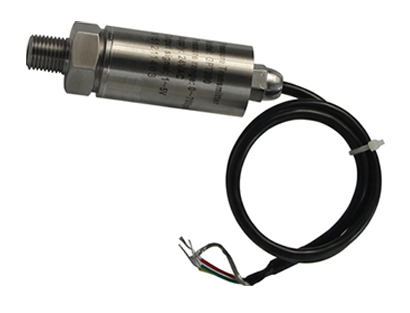
- Cable Pressure Sensors: Monitor pressurized fibre and copper cable networks to detect leaks, pressure drops, or obstructions. Essential for telecom networks that require uninterrupted service.
- Modbus Sensors (Fuel Sensors): Industrial-grade sensors that accurately measure diesel levels, detect consumption patterns, and support generator management.
- Temperature and Humidity Sensor (PLC-ATHS): A high-precision sensor designed to measure temperature and humidity in controlled spaces and equipment rooms.
- Airflow Differential Sensor (PLC-PS-DAF): Measures pressure variations across filters or ducts to maintain airflow efficiency and HVAC performance.
- Power Is Back Solution: A dedicated sensor that instantly reports when grid power returns. This is critical for remote telecom sites and DG-managed locations.
These sensors provide the data foundation for HVAC Monitoring Systems and Remote monitoring hardware solutions.
4. Energy Meters
Energy meters help organizations scale their monitoring environment while improving power intelligence and equipment oversight.
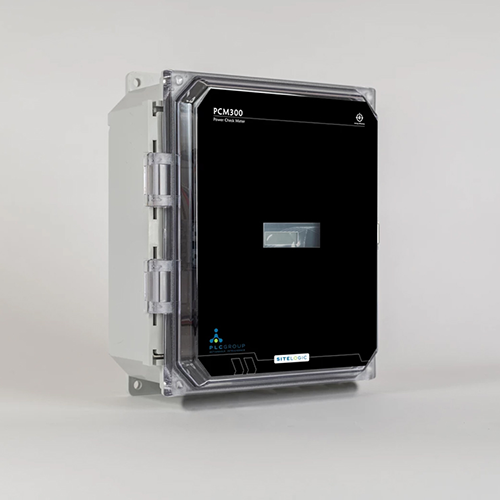
PCM 300 Energy Meter:
A multi-parameter energy meter that records power usage, voltage, current, power factor, and harmonics. It supports energy optimization initiatives and operational planning.
How PLC Group Hardware Works
All hardware components interact via standardized industrial communication protocols. This allows the system to provide:
- Real-time environmental and equipment data
- Accurate control of HVAC, power, and mechanical systems
- Continuous energy measurement and analysis
- Comprehensive alarm detection from multiple sources
- Localized decision-making at the edge
Together, this creates a hardware-driven monitoring framework that supports HVAC Remote Monitoring, energy optimization, and facility automation.
Industries Served
PLC Group hardware is actively deployed across:
- Telecommunications
- Cable landing stations
- Data centers
- Edge environments
- Utilities
- Public safety networks
- Remote industrial sites
Any environment that requires uptime, safety, and efficient operation benefits from robust hardware monitoring and control.
Why Choose PLC Group for Hardware Remote Monitoring and Control
Choosing the right hardware partner is essential to maintaining reliable operations across distributed, mission-critical environments. PLC Group provides a hardware ecosystem that is engineered for durability, interoperability, and long-term performance. Every device is designed to meet real-world site demands while supporting modern automation and monitoring requirements.
Reasons to Choose PLC Group include:
- Industrial grade reliability: Hardware is engineered for harsh conditions, including high heat, dust, vibration, and continuous operation.
- True multi-vendor compatibility: Gateways, controllers, sensors, and meters connect easily to third-party systems using open protocols such as Modbus, SNMP, MQTT, CANBUS, and dry contacts.
- Scalable and modular architecture: Operators can start with a small deployment and expand using additional sensors, or higher-capacity controllers without redesigning the site.
- Edge-level intelligence: Local processing reduces response time, supports autonomous decisions, and maintains operations even when network connectivity is limited.
- Unified platform integration: All hardware integrates seamlessly with the RMC platform, enabling centralized analytics, alarm management, and configuration control.
- Proven performance in critical industries: PLC Group hardware is deployed across telecom networks, data centers, utilities, cable landing stations, and public safety environments.
- Simplified deployment and maintenance: Devices are built with standardized interfaces, clear wiring layouts, and remote configuration capabilities, reducing installation effort and site visits.
- Long product life cycle support: Hardware is backed by long-term availability, firmware updates, and ongoing technical support to protect investment value.
PLC Group delivers hardware that enables real-time visibility, precise control, and operational confidence across complex and remote facilities.
Contact PLC Group
PLC Group delivers a complete hardware foundation for mission-critical monitoring and control. Connect with our technical team to explore gateways, controllers, sensors, and energy meters for your remote and distributed sites.