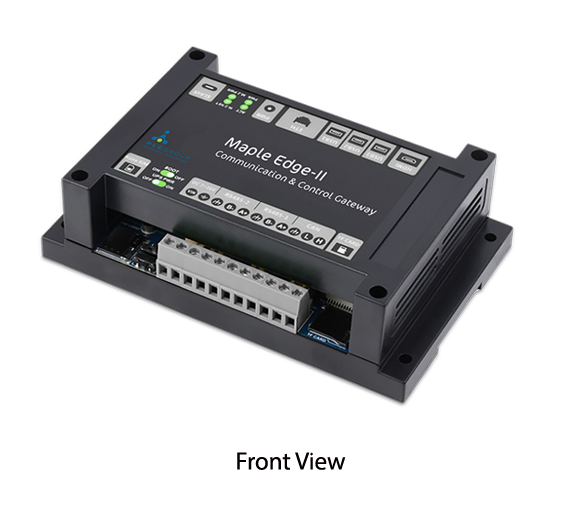
PLC Group’s RMC-1216 delivers centralized remote monitoring and control for telecom operators, data centre teams, and critical facility managers running demanding, distributed environments. Engineered around the operational realities of unmanned sites, the RMC-1216 consolidates environmental, power, and access data into a single controller that keeps operations teams informed and in command.
The result is faster fault response, reduced site visits, and measurable OPEX reductions across your infrastructure footprint.
Key Features of the RMC-1216 Controller
The RMC-1216 controller is built to unify site instrumentation under one intelligent platform, giving operators direct visibility into every critical asset.
- Multi-point I/O capacity supporting environmental sensors, dry-contact signals, alarms, and access-control integration on a single unit.
- Protocol compatibility across Modbus, SNMP, and other industry-standard communication frameworks for straightforward integration with existing NOC systems.
- Local processing capability that preserves autonomous control and data logging during network interruptions or backhaul failures.
- Modular configuration that adapts to shelter, cabinet, or data hall deployments without redesigning the control architecture.
- Secure remote firmware and configuration management, keeping the controller current without requiring a truck roll.
Operational Benefits for Infrastructure Teams
Teams responsible for distributed sites gain measurable operational control when the RMC-1216 remote monitoring controller is deployed across their estate.
- Centralized visibility reduces on-site intervention and accelerates fault response across dispersed facilities.
- Lower operational overhead through fewer dispatches, improved first-time-fix rates, and consolidated alarm handling.
- Native compatibility with our AxIn platform for unified analytics, trending, and alarm management.
- Improved energy efficiency by coordinating cooling, power, and environmental data streams in real time.
- Stronger audit and compliance posture through consistent data capture across every monitored site.
Technical Specifications
The RMC-1216 is specified for the environments where critical infrastructure actually operates, from telecom shelters to cable landing stations. Configurable input and output channel counts, multi-protocol communication interfaces, and a wide power supply range make the controller suitable for both greenfield and retrofit projects. Environmental operating ratings are aligned with telecom shelter, data hall, and coastal deployment conditions, with humidity and temperature tolerances documented for planning teams. Full technical specifications are available through our gated resource library, giving qualified engineers direct access to the RMC-1216 datasheet.
How the RMC-1216 Controller Supports Site Operations
The RMC-1216 controller is designed for unmanned or remote facilities where continuous automated monitoring is not optional. It integrates ICT cooling, DC and AC power systems, generator status, and environmental sensors into a single controller, removing the need for multiple standalone devices. Operators receive real-time alerts and remote diagnostics, allowing NOC teams to triage, resolve, or dispatch with clear situational awareness. Where connectivity drops, local logic and stored data ensure the site continues to protect itself until communications are restored.
The RMC-1216 also supports variable-frequency data acquisition for different types of sensors. This flexibility allows the controller to acquire critical sensor data at high sampling frequencies, enabling rapid identification and detection of abnormal conditions and faults within milliseconds. This provides faster response times and improves overall site reliability, protection, and operational visibility.

Industries and Sectors Served
The RMC-1216 remote monitoring controller is deployed across sectors where uptime is non-negotiable. Primary users include mobile network operators, tower companies, colocation and hyperscale data centres, cable landing stations, and public safety network operators. The platform is proven across North American, European, ASPAC, and MEA deployments, with configurations tailored to regional standards, climate demands, and site typologies.
Why PLC Group’s RMC-1216 Stands Apart
Critical facilities management is a core focus for us, and the RMC-1216 remote monitoring controller was designed with that application in mind. That is reflected in the product’s design trade-offs, favouring deterministic local control, protocol openness, and long service life over generic feature bloat. The controller also integrates natively with the broader controller and RMC platform ecosystem, so expanding your deployment does not mean reworking your monitoring architecture.
Telecom sites are often exposed to harsh outdoor environments, including thunderstorms, lightning activity, heavy rain, dust, humidity, and significant temperature variations. The RMC-1216 is therefore designed with a strong focus on environmental durability, proper grounding, electrical protection, and reliable long-term operation.