For decades, SCADA was the default answer for anyone managing industrial equipment from a central location. It still runs plenty of critical infrastructure today. But as facility portfolios spread across regions, and as budgets shrink while site counts grow, more operations teams are running an industrial IoT monitoring comparison against the SCADA setup they already have.
This isn’t really a story of one technology replacing the other overnight. It’s closer to a shift in what “monitoring” needs to cover, and which approach handles that scope better in 2026. Here’s how industrial IoT monitoring and traditional SCADA actually differ, and where each one earns its place.
For a full breakdown of what a modern industrial IoT monitoring platform includes, see Industrial IoT Monitoring Solutions for Critical Facility Operations.
What SCADA Was Built For
SCADA, short for supervisory control and data acquisition, was designed to control industrial processes at a single site or a tightly connected set of sites. It excels at deterministic, real-time control: opening valves, managing production lines, running the exact logic an engineer configured decades ago. That reliability is a large part of why so much SCADA infrastructure is still in production.
The tradeoff shows up once operations spread out. SCADA architectures were built around local networks and on-premises servers, which makes remote, distributed monitoring across dozens or hundreds of sites expensive to bolt on. Extending a legacy SCADA system to a new remote tower or shelter often means custom integration work rather than a straightforward rollout.
Where Industrial IoT Monitoring Changes the Equation
Industrial IoT monitoring platforms offer cloud-based, scalable device connectivity, analytics, and remote access that go beyond what standard SCADA provides on its own. Instead of a closed, site-bound system, a facility manager gets a single dashboard covering all connected locations, updated continuously rather than pulled during a scheduled poll.
That cloud layer is what makes industrial IoT monitoring a practical SCADA alternative for industrial operations spread across telecom networks, utilities, and data centres. Adding a new site typically means connecting a gateway and sensors, not standing up new local infrastructure.
Connectivity and Integration
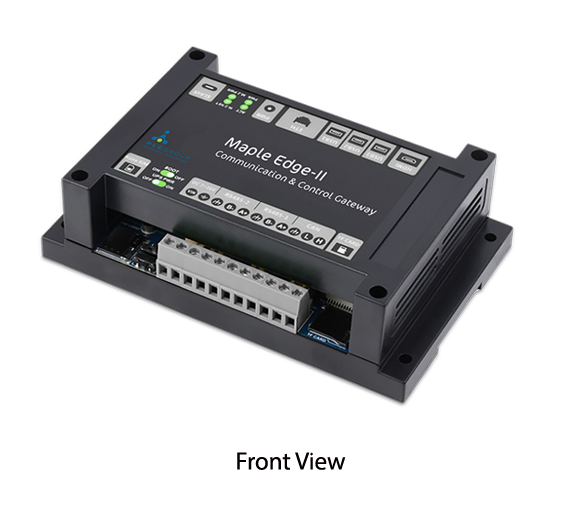
A common misconception is that adopting industrial IoT monitoring means tearing out SCADA and PLC equipment already in place. In practice, the two often coexist. Multi-protocol support for standards including Modbus, BACnet, SNMP, MQTT, and OPC UA lets an industrial IoT platform connect to existing PLCs and legacy controllers instead of replacing them, layering cloud visibility and analytics on top of control systems that already work.
For teams comparing IoT vs SCADA, this integration path matters. It means the decision isn’t strictly either-or. A facility can keep SCADA handling local control logic while an industrial IoT platform handles the remote monitoring, alerting, and analytics that SCADA was never designed to scale across dozens of dispersed sites.
Facility managers weighing this kind of hybrid rollout can review PLC Group’s approach and request a consultation.
Analytics and Decision-Making
This is where the gap between the two approaches is widest. Traditional SCADA systems report the current state of a process. Industrial IoT monitoring platforms, such as PLC Group’s AxIn, apply AI and machine learning to that same data to forecast equipment behavior and flag developing problems before they show up on a screen. Organizations using this kind of analytics report up to 90 percent accuracy in planning and forecasting.
SCADA can tell an operator what’s happening right now. Industrial IoT monitoring adds a layer that tells a facility manager what’s likely to happen next, which changes maintenance planning from reactive to scheduled.
Cost and Scalability
SCADA deployments typically carry high upfront capital costs for local servers, licensing, and site-specific engineering. Industrial IoT monitoring platforms are generally built around a more modular, subscription-friendly model, with hardware and software that scale as sites are added rather than requiring a new local buildout each time.
Facilities using this model report a 10 to 15 percent reduction in total cost of ownership, a number that reflects lower labor costs for manual site visits as much as it does software licensing.
See 7 Benefits of Industrial IoT Monitoring Solutions for Facility Managers for a fuller look at where these cost and analytics gains show up.
Which One Fits Your Operation
Traditional SCADA still makes sense for tightly controlled, single-site industrial processes where deterministic local control is non-negotiable. Industrial IoT monitoring makes more sense once an operation spans multiple sites, needs remote visibility, or wants predictive analytics instead of a static readout.
For most facility managers running distributed infrastructure today, the practical answer is a hybrid one: keep SCADA where it already does its job well, and layer industrial IoT monitoring on top for the visibility, forecasting, and remote access that legacy systems were never built to provide.
For more on the industry pressures pushing facilities toward this hybrid model, see Why Industrial Facilities Are Moving to Remote Monitoring Solutions.
PLC Group designs industrial IoT monitoring solutions that integrate with existing SCADA and PLC infrastructure rather than forcing a rebuild. See how the platform works at PLC Group and talk to the team about what a phased rollout looks like for your sites.