
Industrial IoT Monitoring Solutions in Short
As facility networks grow while on-site headcount stays flat, industrial IoT monitoring has become the standard way telecom, data center, and utility operators protect uptime, control energy spend, and stay audit-ready without adding staff.
This page breaks down the hardware, software, and protocol layers that make up a complete industrial IoT solution, along with how we structure implementation, service, and as-a-service models for operators managing infrastructure they cannot visit daily.
The main takeaway: Industrial IoT monitoring does not just add visibility. It replaces the technician’s drive to a remote site with a continuous data feed that catches problems while they are still small, turning maintenance into a planned cost instead of an emergency one.
Critical facilities do not get a second chance when something goes wrong. A cooling failure at a data center, a power fault at a cell tower, or an unmonitored generator at a remote utility site can cost far more than the repair itself. Downtime disrupts service, damages equipment, and puts safety and compliance at risk.
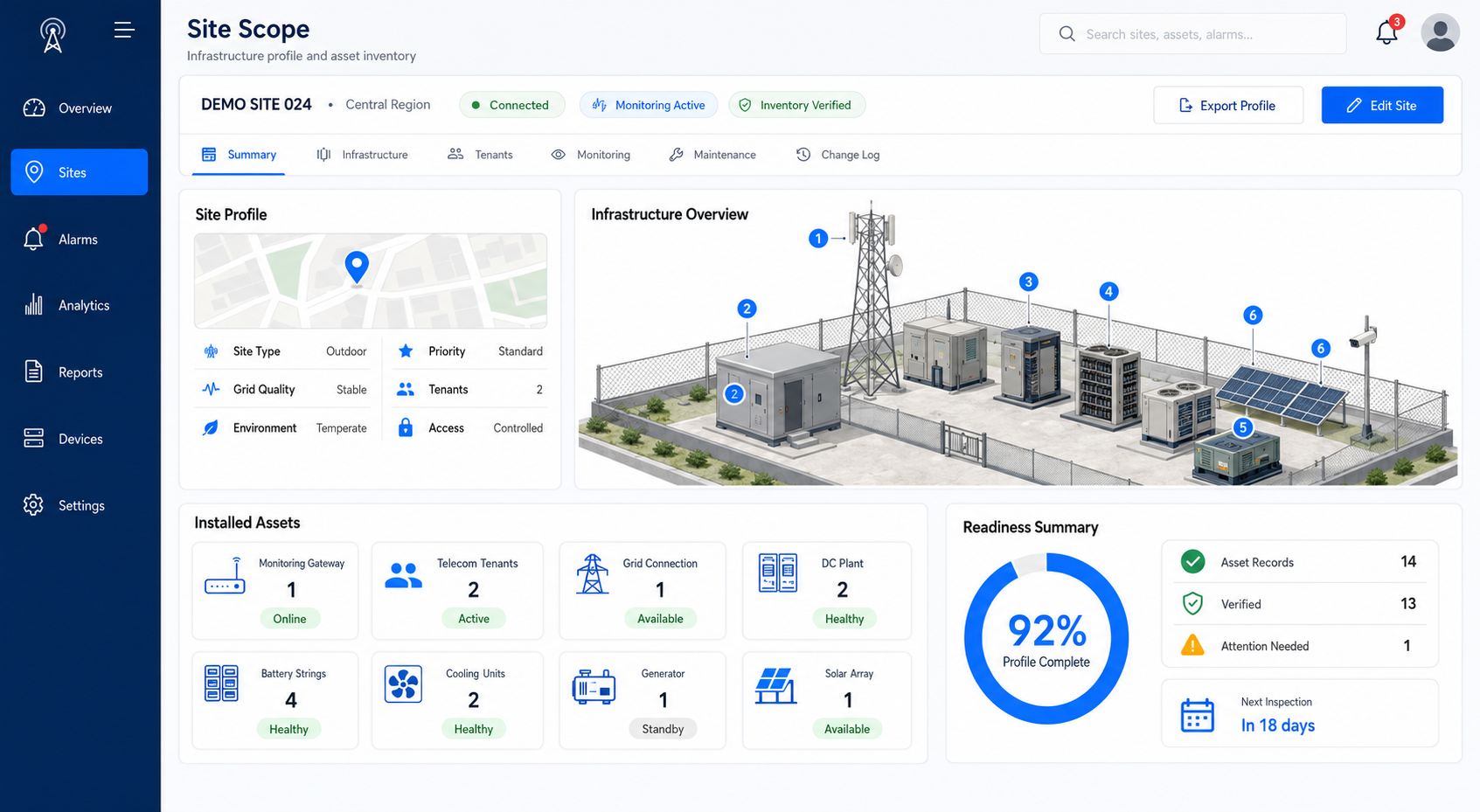
This is the problem industrial IoT solutions are built to solve. By connecting sensors, controllers, and gateways to a central platform, facility teams gain constant visibility into the assets that keep operations running, without needing someone physically on site to check on them.
Industrial IoT monitoring solutions combine hardware, software, and connectivity to give facility teams real-time visibility into power, cooling, security, and equipment health across distributed sites. PLC Group, established in 2014 and based in Mississauga, Ontario, builds these systems specifically for telecom, data center, and utility operators who need to reduce OPEX, prevent downtime, and manage assets they cannot visit on a daily basis.
This page walks through what industrial IoT monitoring solutions actually include, how the components work together, and what to look for when evaluating a provider for your own facilities.
What Industrial IoT Monitoring Solutions Do for Critical Facilities
An industrial monitoring solution collects data from equipment and environmental sensors, then delivers that data to a platform where operations teams can see it, analyze it, and act on it. That sounds simple, but the value comes from what happens with the data once it is collected.
Instead of a technician driving to a remote tower site to check whether a generator started correctly, a monitoring platform reports that status automatically. Instead of discovering a cooling unit failure after temperatures have already climbed past safe limits, an alarm fires the moment conditions start to drift.
PLC Group’s approach centers on converting operational data into measurable financial value. The goal is not just visibility for its own sake. It is using that visibility to unlock efficiencies, reduce energy consumption, and support long-term CAPEX and OPEX optimization across telecom networks, utilities, and data centres.
That shift, from reactive maintenance to continuous, data-driven oversight, is what separates a modern industrial IoT deployment from older monitoring approaches that relied on manual checks and periodic site visits.
For a closer look at what is driving this shift across telecom, data center, and utility operators, see Why Industrial Facilities Are Moving to Remote Monitoring Solutions.
Book a consultation to see how this works for your facility network.

Core Functional Capabilities of an Industrial IoT Platform
Underneath the hardware and software, a mature industrial IoT platform is built around a specific set of functional capabilities that work together rather than in isolation.
- Fault surveillance flags equipment or environmental issues as they develop, rather than after a scheduled inspection catches them.
- Site management gives operations teams a single view of conditions across many locations, instead of separate reports for each one.
- Analytics and BI turn raw sensor data into trends and forecasts that support planning decisions, not just historical logs.
- Alarms management centralizes alerts so the right team member is notified the moment a threshold is crossed.
- Tenant management supports facilities that host multiple tenants or service providers on shared infrastructure, keeping oversight separated where it needs to be.
- Operational excellence tools help standardize processes across a network of sites so performance does not depend on which technician is on shift.
- Energy efficiency capabilities track consumption patterns and surface opportunities to cut waste without sacrificing reliability.
These capabilities are what turn a collection of sensors into an actual management system, one that a facility team can use to run daily operations rather than just monitor them from a distance.
Ask PLC Group for a walkthrough of these capabilities in action.

Core Components of an Industrial IoT Monitoring System
A complete IoT monitoring solution is built from several layers of hardware and software working together. Each layer has a distinct job, and the system only performs well when all of them are integrated properly.
Gateways and Edge Connectivity
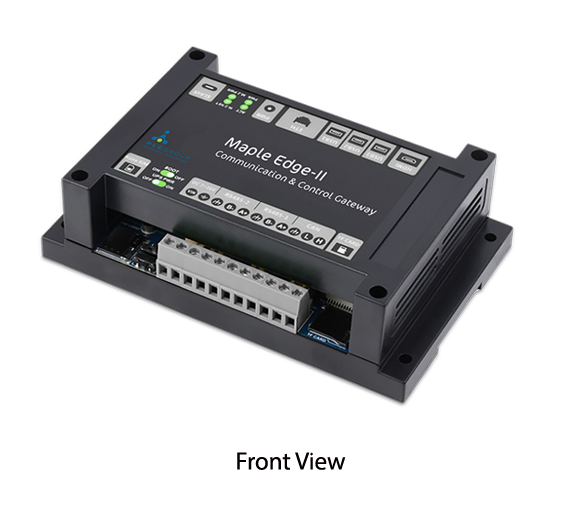
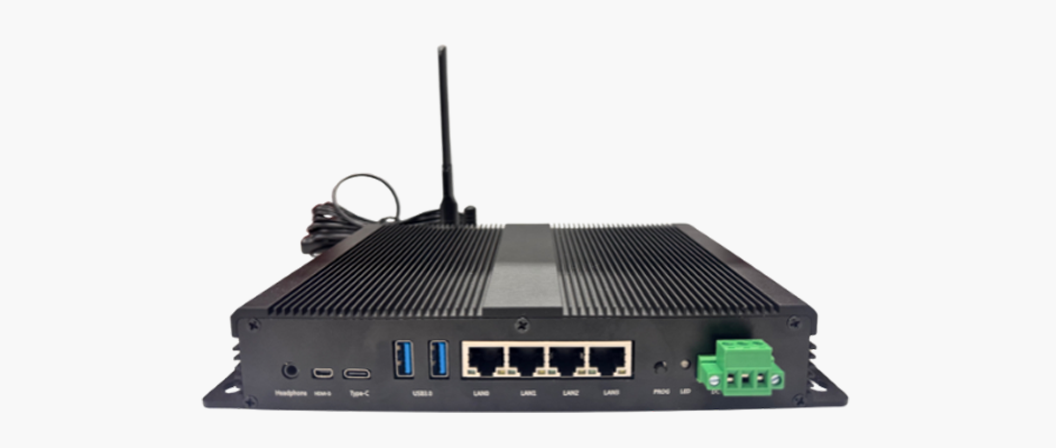
Gateways sit at the edge of the network, collecting data from local devices and sensors before sending it to the central platform. PLC Group’s Maple Edge II and Maple Edge III gateways handle this role, supporting dual-path connectivity so a site does not lose visibility if one connection drops.
Controllers and Automation Hardware
Controllers manage the automated logic that keeps equipment operating within set parameters. PLC Group’s TCU-MiniT and TCU-MiniT+ controllers are built for industrial automation tasks where precise, reliable control matters, particularly in environments where a controller may run unattended for extended periods.

Sensors and Energy Meters
Sensors measure the physical conditions inside a facility, temperature, humidity, power draw, and more, while energy meters track consumption patterns that feed directly into cost and efficiency reporting. Together, these devices are the source of the raw data that everything else in the system depends on.
The AxIn Platform for Actionable Intelligence
Once data reaches the platform layer, it needs to become useful. PLC Group’s AxIn platform applies artificial intelligence and machine learning to that incoming data, supporting predictive maintenance, smart operations, and optimized energy consumption. Rather than simply displaying numbers on a dashboard, AxIn helps teams anticipate problems before they interrupt service.

Talk to PLC Group about which hardware configuration fits your site.
How Implementation Works, From Planning to Scale
Deploying an industrial IoT monitoring system is not a single event. PLC Group structures the process around three phases, each building on the last.
- Collaborate comes first. This stage brings internal teams, partners, and the facility operator together to build a shared understanding of goals, constraints, and existing infrastructure. Skipping this step is one of the more common reasons monitoring deployments underdeliver, since a platform configured without input from the people running the facility day to day rarely matches how the site actually operates.
- Innovate is where the specific technology and configuration decisions get made. This includes selecting the right combination of gateways, controllers, sensors, and platform features based on the goals established in the first phase, along with any integration work needed to connect existing equipment.
- Transform is the deployment and scale-up stage, where a proven configuration moves from a pilot or single site into a broader rollout across a facility network. This is also where the ongoing management and optimization work begins, since a monitoring system’s value compounds over time as more historical data feeds into the analytics and predictive maintenance capabilities.
Connect with PLC Group to map out your own Collaborate, Innovate, Transform timeline.
Fault Surveillance and Alarm Management Across Distributed Sites
For organizations managing dozens or hundreds of remote sites, fault surveillance is one of the most immediate benefits of industrial IoT monitoring. A facility team cannot staff each location around the clock, so the monitoring system needs to do the watching instead.
PLC Group’s alarm management solution centralizes alerts from across a facility network, including tower light monitoring for telecom infrastructure where visible warning systems must stay operational for safety and regulatory reasons. When a fault occurs, the system flags it immediately rather than waiting for a scheduled inspection to catch it.
This matters because the cost of a missed fault is rarely just the repair. It is the downtime, the service disruption, and in regulated industries, the compliance exposure that follows.
Get a demo of PLC Group’s alarm management dashboard.

Energy Efficiency and Cooling Management for Critical Infrastructure
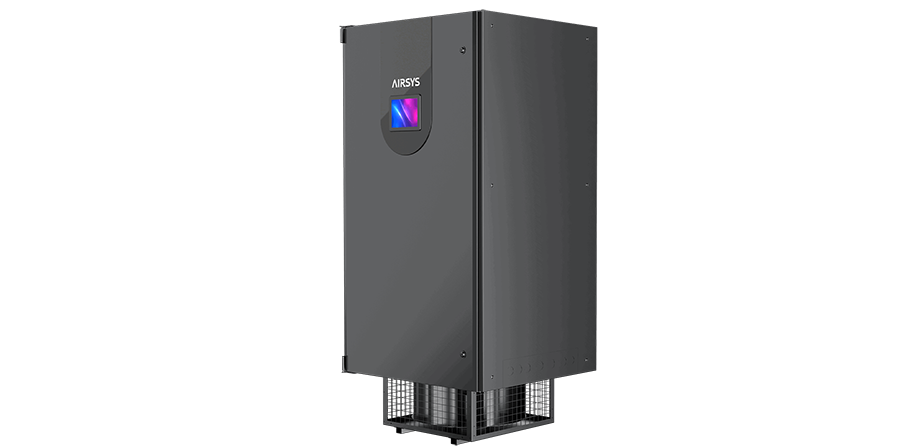
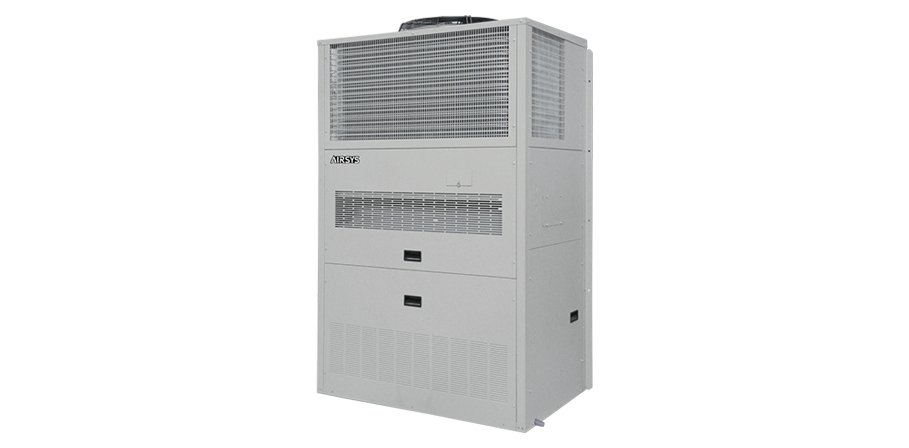
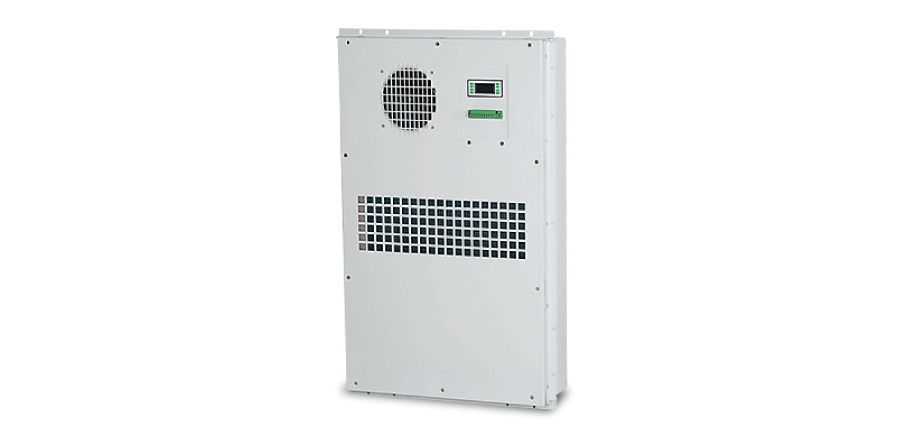
Cooling and energy costs represent a significant share of ongoing operational spend for data centers, telecom shelters, and utility facilities. PLC Group’s cooling management and ICT cooling solutions are engineered specifically for these environments, covering data center and head-end cooling, shelter and modular building cooling, and cabinet-level cooling.
Energy management extends beyond cooling. PLC Group’s broader energy management solution includes virtual power plant capabilities, renewable energy integration, energy demand management, billing reconciliation, and generator monitoring and control. Each of these pulls from the same underlying monitoring infrastructure, so facility teams are not managing separate, disconnected systems for power and for cooling.
According to PLC Group, organizations using its as-a-service models have seen a 10 to 15 percent reduction in facilities total cost of ownership, along with up to 90 percent accuracy in planning and forecasting through AI-driven analytics.
Speak with PLC Group about reducing energy and cooling costs at your sites.

Security and Access Control as Part of Facility Monitoring
Physical security is not separate from operational monitoring. It is part of the same picture. PLC Group’s security management solution includes access control designed to work alongside environmental and power monitoring, so a facility team gets one unified view of who is on site, what equipment is doing, and whether conditions are within normal range.
This integration matters most for facilities where unauthorized access is not just a security concern but an operational one. A cabinet left open at a remote site, for example, can affect cooling performance and equipment reliability, not only physical security.
Contact PLC Group to discuss access control for your facility network.
Industries That Depend on Industrial Monitoring Solutions
Industrial IoT solutions are not one-size-fits-all. PLC Group builds its systems around the specific demands of a handful of industries where uptime and remote visibility carry the highest stakes.
- Telecommunications: Tower and shelter monitoring that keeps networks running without constant site visits.
- Data Centers: Power, cooling, and uptime optimization for facilities where downtime has an immediate and measurable cost.
- Cable Landing Stations: Monitoring and control for coastal communication infrastructure, often in locations with limited on-site staffing.
- Utilities: Reliable energy performance that depends on accurate data and responsive control systems.
- Public Safety Networks: Continuous reliability for mission-critical communication facilities where failure is not an option.
- Renewable Energy: Monitoring that supports consistent output and performance tracking across distributed generation sites.
- Facilities Management: Broader building and infrastructure oversight for organizations managing multiple sites.
Each of these sectors shares a common challenge: assets are spread across locations that are difficult or costly to visit regularly, which makes remote visibility an operational necessity rather than a convenience. A telecom operator managing hundreds of tower sites faces a different set of pressures than a single data center campus, but both depend on the same underlying principle: knowing the status of an asset without needing a person standing next to it.
This is also why industrial monitoring solutions rarely work as an off-the-shelf product. A cable landing station has environmental and security requirements that a public safety network does not share, and a renewable energy site often needs performance tracking tied to output forecasting rather than just fault detection. Matching the platform’s configuration to the industry, not just the hardware, is part of what determines whether a deployment actually reduces operational burden or just adds another dashboard to check.
Tell PLC Group about your industry and get a tailored recommendation.
Turnkey Implementation, Engineering, and Managed Services
Hardware and software are only part of a successful deployment. PLC Group also provides the services needed to plan, build, and maintain an industrial monitoring system over its full lifecycle.
Turnkey implementation covers the full path from concept to deployment, so a facility team is not left to piece together hardware, software, and integration work on their own. Engineering and design services address the technical challenges specific to a facility’s layout, existing infrastructure, and operational requirements. Managed services then take on the ongoing work of keeping the system running smoothly, with proactive management rather than a break-fix approach.
This combination matters for organizations that do not have a large internal team dedicated to IoT infrastructure. Instead of hiring and training specialized staff, they can rely on a provider that handles implementation and ongoing management as a single, coordinated service.
Reach out to discuss which service model fits your team’s capacity.
As-a-Service Models That Remove the CAPEX Barrier
One of the more significant shifts in how organizations adopt industrial IoT solutions is the move away from large upfront hardware purchases. PLC Group offers several as-a-service models built around this shift, spanning Actionable Intelligence, RMS, Software, and Cooling.
- Actionable Intelligence as a Service requires no additional hardware, relying instead on existing data and AI to drive results, with a performance-based fee structure that ties cost to actual outcomes.
- RMS as a Service combines zero CAPEX with a fixed remote monitoring system fee that includes hardware, software, and maintenance, giving facility teams predictable costs instead of large capital outlays.
- Cooling as a Service provides zero CAPEX investment for cooling infrastructure, a pay-per-use model based on IT load cooling consumption, and support for reduced carbon footprint targets.
- Software as a Service delivers the platform layer on a subscription basis, giving teams access to analytics and control tools without owning the underlying infrastructure.
Across these models, the underlying appeal is the same: facility teams get modern monitoring capability without the capital expense that traditionally came with it, and costs stay tied to measurable OPEX savings rather than fixed depreciation schedules.
Ask which as-a-service model fits your facility’s budget and goals.
Key Features That Set PLC Group’s IoT Monitoring Apart
Not all industrial IoT platforms are built to the same standard. A few technical features determine whether a system holds up under real-world, mission-critical conditions.
- Modular architecture that scales as a facility network grows, without requiring a system overhaul.
- Multi-protocol support, including SNMP, Modbus, BACnet, MQTT, and OPC UA, so third-party equipment and legacy controllers can connect without forcing a full hardware replacement.
- Dual-path connectivity and local data buffering, which keeps data flowing even when a primary connection goes down.
- Adaptive dashboards with both historical and real-time data visualization, giving teams context rather than just a snapshot.
- Role-based access and secure remote configuration, so the right people have the right level of control without exposing the whole system.
- Ruggedized field devices rated for harsh industrial conditions, built for environments where consumer-grade hardware would not survive.
This combination of protocol flexibility and rugged hardware is part of what allows PLC Group’s systems to integrate with equipment from established manufacturers, including Vertiv, Siemens, Cummins, CAT, HID, and Axis Communications, rather than requiring a facility to rip out existing infrastructure.
That OEM integration works in both directions. Equipment manufacturers can build PLC Group’s monitoring and control capability directly into their own products, while facility operators can connect the cooling units, generators, access control panels, and power systems they already have installed. For a facility team evaluating a monitoring platform, this matters because it removes one of the biggest barriers to adoption: the assumption that modernizing monitoring means replacing equipment that is still working fine. In most cases, the existing hardware stays in place, and the monitoring layer gets added on top of it.
This is also where industrial IoT monitoring diverges most from legacy control systems. See Industrial IoT Monitoring Solutions vs Traditional SCADA Systems for a full comparison.
Ask PLC Group whether your current equipment is already compatible.
Benefits of Remote Monitoring for Facility Operations Teams
The practical benefits of a well-implemented industrial monitoring solution show up across several parts of facility operations.
Enhanced uptime comes from continuous monitoring that detects failures before they cause a service disruption, rather than after the fact. Operational efficiency improves because automation reduces the number of manual inspections and site visits a team needs to schedule. Energy savings follow from intelligent analytics that optimize power and cooling usage based on actual conditions rather than fixed schedules.
Reduced maintenance costs result from predictive diagnostics that catch problems early, before they turn into unplanned downtime. Improved compliance is easier to maintain when centralized data supports the regulatory and safety reporting many critical facilities are required to produce. And scalable control means the system can expand as facility demands grow, without needing to be rebuilt from scratch.
Taken together, these benefits explain why industrial IoT monitoring has moved from a nice-to-have upgrade to a standard part of how telecom, data center, and utility operators manage their infrastructure.
For a full breakdown of these gains by category, see 7 Benefits of Industrial IoT Monitoring Solutions for Facility Managers.
Request a benefits breakdown specific to your facility type.
How to Choose the Right Industrial IoT Monitoring Partner
Selecting a provider for industrial monitoring solutions comes down to a few practical questions. Does the hardware support the protocols your existing equipment already uses? Can the platform scale as your facility network grows, or will it need to be replaced in a few years? Is there a service model, whether owned hardware or an as-a-service subscription, that matches how your organization prefers to manage costs?
It also helps to look at the provider’s service model beyond the technology itself. Turnkey implementation, engineering support, and managed services matter just as much as the hardware specifications, particularly for teams that do not have dedicated in-house IoT expertise.
Finally, consider how well the provider’s experience matches your industry. A system built primarily for retail environments will not necessarily handle the demands of a cable landing station or a telecom tower site. PLC Group’s focus on telecom, data centers, utilities, and public safety networks reflects the specific operational pressures those industries face.
Schedule a call with PLC Group to evaluate your facility’s requirements.