
Remote Monitoring Hardware for Unmanned Edge Sites at a Glance
Remote monitoring hardware for unmanned edge sites is the on-site physical layer of gateways, controllers, sensors, and energy meters that sense conditions, control equipment, and report status to a central platform without staff present. It gives distributed facilities continuous visibility, environmental stability, energy optimization, and fast response across mission-critical operations. A complete unmanned site monitoring hardware stack combines four cooperating parts: gateways such as the Maple Edge-II and Maple Edge-III act as the communication bridge between field equipment and the RMC platform; controllers such as the TCU-NG2 and RMC-1216 manage equipment behavior and control HVAC, generators, batteries, and DC plants; sensors capture temperature, humidity, airflow, fuel level, cable pressure, and grid return; and the PCM 300 energy meter records power usage, voltage, current, power factor, and harmonics.
Main takeaway: PLC Group provides this complete hardware ecosystem, engineered for accuracy, durability, and interoperability across telecom towers, data centers, edge sites, utilities, and cable landing stations. Because the hardware is built to sense, control, and communicate with precision and includes edge-level logic that reduces network dependency, operators can maintain optimized and reliable facilities even in remote or unmanned environments.
Distributed infrastructure has outrun the old model of sending a technician to look. Telecom towers, edge compute nodes, substations, and coastal cable stations now run for weeks with no one inside, yet the equipment still generates heat, burns fuel, drains batteries, and drifts out of tolerance. When a fault goes unseen at a site no one visits, a small problem can become an outage, and the cost shows up as emergency call-outs, shortened equipment life, and lost uptime.
The difference between a site that corrects itself and one that fails quietly comes down to the remote monitoring hardware installed at the edge. The right stack senses conditions accurately, acts on HVAC and power systems locally, and reports back to a central platform, so operators keep full visibility and control without standing on site. Getting that stack right depends on understanding how each layer works together, from the sensors that detect a problem to the controllers that respond to it and the gateways that carry the data out.
The sections below break down what belongs in an unmanned site monitoring hardware build and how to specify it with confidence: the sensing and control layers, what a device must keep doing when the network drops, how to size and harden it for the field, and which edge site monitoring equipment fits each type of site. Every capability described reflects PLC Group’s own hardware portfolio, proven across a decade of deployments in mission-critical, unmanned environments.
Building a hardware stack for sites no one staffs daily? Explore PLC Group’s industrial IoT and remote monitoring solutions.
Why Unmanned Sites Fail: The Real Cost of Blind Spots and Repeat Truck Rolls
An unmanned site does not fail all at once. It fails in the gap between a problem starting and anyone finding out. A cooling unit trips, temperature climbs, and thermal stress shortens the life of the very equipment the site exists to protect. Because no one is present to notice, a small deviation compounds into a service-impacting event rather than resolving as a single clean fault, which is why continuous visibility is the whole point of the hardware layer.
Three failure patterns show up again and again on distributed sites:
- Silent environmental drift — overheating and condensation degrade components before any human notices, turning a preventable adjustment into a hardware replacement.
- Power-chain surprises — a generator that will not start, a battery that has quietly failed, or fuel that has been drained leaves the site dark at the worst moment.
- Repeat truck rolls — without remote visibility, every alarm becomes a drive, and every drive without the right part becomes a second drive.
The cure isn’t more visits; it is edge site monitoring equipment that removes the need to visit. PLC Group’s approach reduces operational expenditure and manual site visits precisely because the devices catch failures before they cause disruption, replacing reactive driving with continuous, automated oversight.
The cost of a blind spot is rarely a single line item. Overheating and thermal stress shorten component lifespan, condensation and high humidity drive corrosion and short circuits, and reactive or poorly optimized HVAC runs up uncontrolled energy consumption. Each of those is a quiet tax that accrues between visits. Continuous monitoring flips the economics: failures are detected before they cause disruption, automation reduces manual inspection, intelligent analytics optimize power and cooling use, and predictive diagnostics prevent unplanned downtime. The savings aren’t one avoided outage, but the steady removal of the conditions that produce outages in the first place.
See how continuous oversight cuts unplanned dispatches with PLC Group’s remote monitoring and management solutions.
What Counts as Remote Monitoring Hardware: Gateways, Controllers, Sensors, and Energy Meters
Remote visibility only works when the underlying hardware is designed for accuracy, durability, and interoperability. PLC Group organizes its hardware into four categories for remote monitoring and control, and gateways, controllers, sensors, and energy meters work together to provide continuous visibility, environmental stability, energy optimization, and fast response across mission-critical operations.

Gateways: the communication bridge
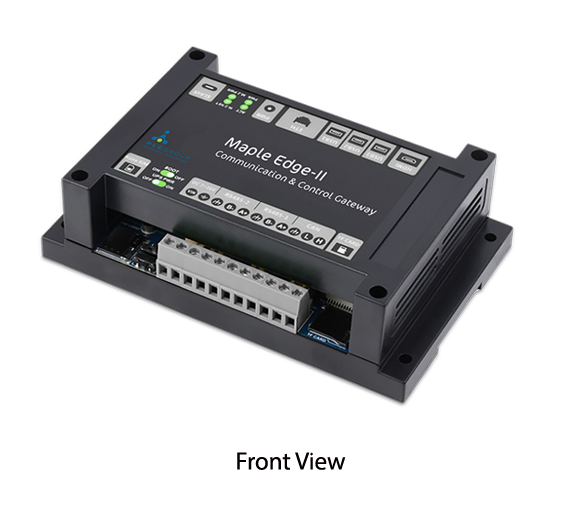
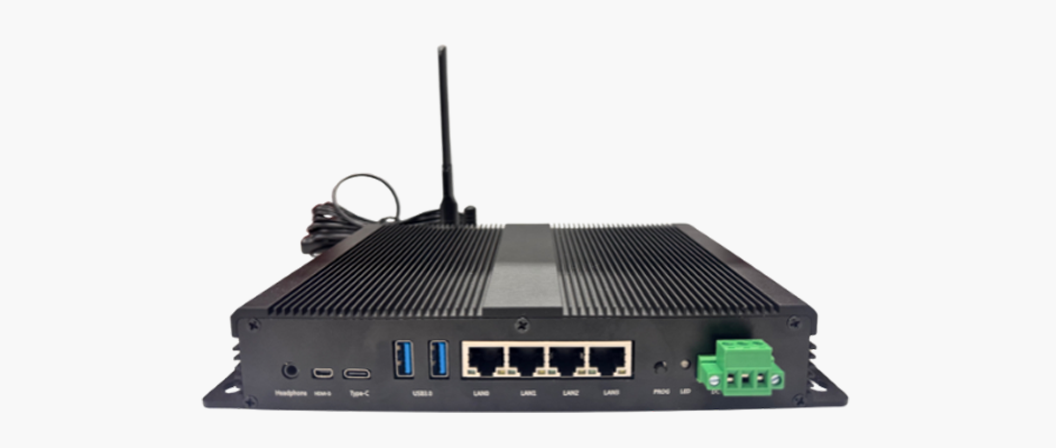
Gateways serve as the primary communication bridge between field equipment and the RMC platform, gathering telemetry, executing commands, and ensuring secure site-to-cloud communication. The Maple Edge-II is a compact, rugged edge gateway engineered for distributed sites and micro-installations, suited to telecom shelters and remote enclosures, while the Maple Edge-III is a high-performance gateway with higher input and output capacity, enhanced processing power, and local data storage and event logging, ideal for data centers and utility facilities.
Controllers: local command authority
Controllers manage equipment behavior, automate cooling sequences, regulate environmental stability, and deliver precise command control. The range spans the compact TCU-MiniT+ for smaller environments and HVAC units, the TCU-800 Micro for telecom and edge environments with predictive operation logic, the RMC-1216 universal controller for high-density operations, and the flagship TCU-NG2, which combines controller, gateway, and aggregator functions for telecom sites, cable landing stations, and edge data centers.
Sensors and energy meters: the data foundation
Sensors provide the real-time data required for accurate monitoring and automation, and energy meters help organizations scale their monitoring environment while improving power intelligence and equipment oversight. Together with gateways and controllers, they create a hardware-driven framework where accurate sensing, local control, continuous energy measurement, and multi-source alarm detection all feed one system.
| Hardware Class | Primary Role | Representative PLC Group Devices |
|---|---|---|
| Gateways | Bridge field equipment to the platform; secure telemetry and command relay | Maple Edge-II, Maple Edge-III |
| Controllers | On-site logic and command over HVAC, power, and mechanical systems | TCU-NG2, RMC-1216, TCU-800 Micro, TCU-MiniT+ |
| Sensors | Sense environmental, power, and mechanical parameters | Cable Pressure, Fuel (Modbus), PLC-ATHS, PLC-PS-DAF, Power Is Back |
| Energy Meters | Measure power usage and quality for optimization and planning | PCM 300 |
These classes are defined by role, not by brand lock-in. All components interact through standardized industrial communication protocols, which allow the system to deliver real-time environmental and equipment data, accurate control of HVAC, power, and mechanical systems, continuous energy measurement, comprehensive alarm detection from multiple sources, and localized decision-making at the edge from one coherent stack. Viewing the four classes as a framework rather than a shopping list is the first step in writing a specification that will still make sense as the site grows.
Explore PLC Group’s industrial automation controllers to specify the on-site command layer for your build.
The Sensing Layer: Temperature, Humidity, Airflow, Fuel Level, Cable Pressure, and Grid-Return Detection
The sensing layer is where an unmanned site earns its situational awareness. Each PLC Group sensor targets a specific failure mode, and getting the specification right starts with knowing the remote monitoring sensors that suit each measurement and how to verify them before you buy.
- Temperature and humidity (PLC-ATHS) — a high-precision sensor for controlled spaces and equipment rooms, catching the thermal and moisture drift that quietly shortens component life.
- Airflow differential (PLC-PS-DAF) — measures pressure variation across filters or ducts to keep airflow efficient and flag a clogged filter before HVAC performance drops.
- Fuel level (Modbus fuel sensors) — industrial-grade sensors that measure diesel levels, detect consumption patterns, and support generator management, exposing both shortfalls and theft.
- Cable pressure — watches pressurized fiber and copper networks for leaks and obstructions that would otherwise interrupt service, so a slow loss becomes an early alert rather than an outage.
- Grid-return detection (Power Is Back) — a dedicated sensor that instantly reports when grid power returns, critical for remote telecom sites and generator-managed locations.
Because these sensors are engineered for reliability in demanding environments and share a common interface approach, an operator can read very different parameters through one consistent scheme rather than wiring each point as a special case. That uniformity is what makes a multi-sensor site practical to build and maintain.
Power intelligence rounds out the sensing picture. The PCM 300 energy meter is a multi-parameter device that records power usage, voltage, current, power factor, and harmonics, supporting energy optimization initiatives and operational planning. On an unmanned site, that metering does double duty: it exposes the efficiency of the cooling and power systems the other sensors watch, and it feeds the analytics that turn raw readings into the trend lines an operator acts on. Sensing the environment and measuring the energy it consumes are two halves of the same visibility problem.
Build your sensing layer with PLC Group’s remote monitoring sensor range.
The Control Layer: On-Site HVAC Sequencing, Generator, Battery, and DC Plant Command
Sensing tells you what is happening; the control layer acts on it without waiting for a human. PLC Group controllers manage equipment behavior, automate cooling sequences, regulate environmental stability, and issue precise commands to the systems that keep a site alive.
The TCU-NG2 illustrates the reach of a full control device. It performs real-time monitoring and control of HVAC across single or dual units with lead-lag logic spanning smart and legacy equipment, and extends command to generators, batteries, DC plants, fuel, and block heaters. That breadth matters on an unmanned site, where cooling, backup power, and battery health are the three systems most likely to decide whether the site survives an outage.
For high-density operations, the RMC-1216 universal controller supports environmental sensors, energy inputs, and external systems with remote configuration and firmware updates, making it suited to complex site automation. Backup power deserves its own line on the specification. A controller that can command generators, batteries, DC plants, fuel, and block heaters turns the backup chain from a set of unmonitored parts into a system the site can test, exercise, and protect on its own, across both intelligent and non-intelligent gensets.
What distinguishes a control layer from a collection of relays is coordination. A controller that can sequence dual HVAC units with lead-lag logic spreads wear across machines and keeps one in reserve, while the same device watching battery and DC-plant health can hold a site through a grid event and hand it back cleanly when power returns. Because these controllers interoperate with both intelligent and legacy equipment over open protocols, an operator does not have to replace a working generator or air conditioner to gain command of it. That is the practical shape of local command authority: one device deciding, in the right order, across the systems that keep an unmanned site alive.
Bring generators, batteries, and fuel under one system with PLC Group’s generator and fuel monitoring system.
Edge Autonomy: What Hardware Must Do When Backhaul Goes Down
Connectivity to a remote site is a convenience, not a guarantee. The real test of remote monitoring hardware is what it keeps doing when the link drops. PLC Group builds edge-level logic into its devices specifically so that local processing reduces response time, supports autonomous decisions, and maintains operations even when network connectivity is limited.
Three properties define genuine edge autonomy in this hardware:
- Local decision-making — the TCU-NG2 provides edge computing and edge control functionality, so cooling sequences and protective actions continue on device rather than stalling until the cloud answers.
- On-board logging — the Maple Edge-III carries local data storage and event logging, preserving the record of what happened during an outage so nothing is lost when the link returns.
- Resilient backhaul — the TCU-NG2 supports LTE and IP backhaul with optional Wi-Fi, plus remote VPN access, cloud integration, and remote firmware upgrades, giving more than one path back to the platform.
This edge-first design is what lets operators maintain optimized, reliable facilities even in remote or unmanned environments, rather than trading uptime for a stable connection they cannot promise.
Autonomy also changes what the backhaul is for. When decisions live on the device, the network carries confirmation and analytics rather than second-by-second control traffic, which is a gentler load on an LTE link at a remote tower. And because the same devices support remote VPN access and remote firmware upgrades, a site that recovers its connection can be reconfigured or updated without a visit, closing the loop between edge independence and central oversight. The goal is not a site that ignores the platform, but one that never depends on it to survive.
It helps to map each autonomous function to the failure it prevents during a backhaul outage:
| When Backhaul Drops | Hardware Function | Failure Prevented |
|---|---|---|
| Cooling demand changes | Edge control continues HVAC sequencing on device | Thermal runaway while the cloud is unreachable |
| Grid power fails then returns | Local generator, battery, and grid-return logic act on site | Extended generator runtime or a site left dark |
| Events occur unseen | On-board logging on Maple Edge-III records them | Lost history and undiagnosable incidents |
| Primary link is down | LTE, IP, and optional Wi-Fi provide alternate paths | Total loss of contact with the site |
Extend edge autonomy across every site through PLC Group’s edge software and platform layer.

Sizing I/O, Power Budget, and Enclosure Hardening Before You Buy
The specification stage determines whether a deployment scales or must be redesigned. PLC Group’s architecture is scalable and modular, so operators can start with a small deployment and expand with additional sensors or higher-capacity controllers without redesigning the site. Every specification sheet should include three sizing questions.
Input and output capacity
Count the points to sense and the equipment to control, then match the device. A micro-installation may only need the Maple Edge-II, while a multi-equipment facility calls for the higher input and output capacity of the Maple Edge-III or the RMC-1216’s support for environmental sensors, energy inputs, and external systems. The TCU-NG2 offers flexible input and output options for sites that aggregate many devices behind one controller.
Protocol and interoperability budget
Specify for the equipment you already own. PLC Group hardware supports secure data acquisition through Modbus, SNMP, MQTT, CANBUS, and dry contacts, and interoperates with both intelligent and legacy equipment, so you don’t need to replace aging assets to monitor them. True multi-vendor compatibility keeps the door open to third-party systems using these open protocols.
Durability and long-term support
Unconditioned enclosures are unforgiving, so the specification must state the environmental rating explicitly rather than assume it. PLC Group hardware is engineered for harsh conditions and continuous operation, and it is backed by long-term availability, firmware updates, and ongoing technical support that protect the investment across the life of the site. Standardized interfaces, clear wiring layouts, and remote configuration reduce both installation effort and future site visits, which is where a well-specified build pays back over years.
Explore PLC Group’s energy meters to add power oversight to your specification.
Deployment Patterns Across Cable Landing Stations, Edge Data Centers, Substations, and Public Safety Sites
The same four device classes assemble differently depending on the site. PLC Group hardware is actively deployed across telecommunications, cable landing stations, data centers, edge environments, utilities, public safety networks, and remote industrial sites, and each has a characteristic hardware emphasis.
| Site Type | Hardware Emphasis | Why It Fits |
|---|---|---|
| Cable landing stations | Cable pressure sensing, HVAC control, power-chain visibility, TCU-NG2 aggregation | Coastal, high-moisture endpoints of undersea cable where uptime and sealed environments are critical |
| Edge data centers | Maple Edge-III, RMC-1216, airflow and temperature sensing, PCM 300 metering | Multi-equipment sites needing higher I/O, local logging, and energy oversight |
| Substations/utilities | Multi-protocol gateways, energy metering, alarm detection | Distributed power assets that must integrate with legacy and intelligent equipment |
| Public safety sites | Grid-return detection, generator and battery command, environmental sensing | Sites that must guarantee stable power and cooling for uninterrupted emergency communication |
For coastal cable stations in particular, the hardware supports continuous monitoring of temperature, humidity, voltage, current, and energy performance, with early warnings of equipment stress or HVAC inefficiency, which is exactly the profile a minimally staffed facility requires.
What the patterns share is more instructive than what separates them. Every site type relies on the same four device classes and the same open protocols, so an operator running telecom towers, an edge data center, and a public safety hub isn’t learning three unrelated systems. A gateway that speaks Modbus and SNMP at a substation speaks them the same way at a landing station; a controller that sequences HVAC in an edge cabinet applies the same logic in a shelter. That consistency is what turns a portfolio into a standard, letting a team specify, deploy, and maintain across a mixed estate with one skill set and one platform behind it.
Running a multi-equipment site? See how the same hardware scales in PLC Group’s data center infrastructure management.
What to weigh in a hardware partner
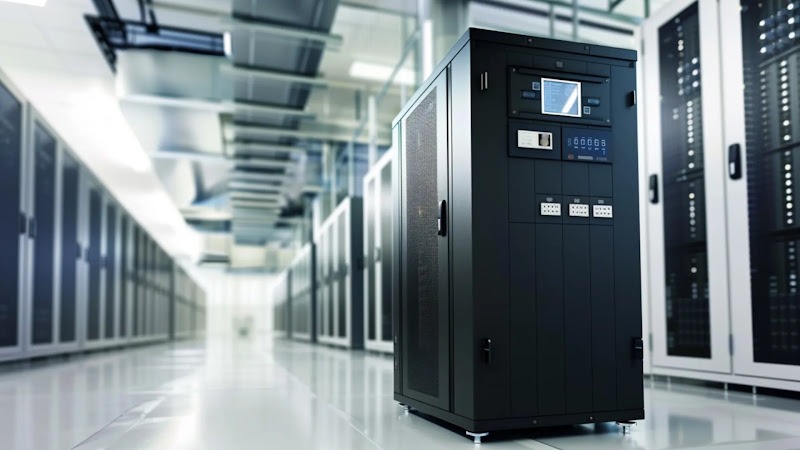
Devices are only half the decision; the partner behind them is the other half. PLC Group frames its hardware advantage around qualities that show up long after commissioning. The hardware offers industrial-grade reliability for heat, dust, vibration, and continuous duty, plus true multi-vendor compatibility across Modbus, SNMP, MQTT, CANBUS, and dry contacts. Its scalable, modular architecture grows without a redesign, and edge-level intelligence supports local, autonomous decisions. Everything integrates with one platform for centralized analytics and alarm management, with proven performance across telecom, data centers, utilities, cable landing stations, and public safety environments. Simplified deployment through standardized interfaces and remote configuration, backed by long product life-cycle support, is what keeps that value in place over the years.
Turn site data into decisions with PLC Group’s Actionable Intelligence as a Service.
Building Your Hardware Specification Sheet: Evaluation Checklist and Next Steps
A defensible specification sheet turns the sections above into decisions. Work through the checklist below, mapping each row to a PLC Group device class, and you will arrive at a build sized for the site rather than for a catalog.
Sensing coverage: list every parameter that must be watched, including temperature, humidity, airflow, fuel level, cable pressure, and grid return, and assign a sensor to each.
Control scope: identify what must be commanded locally, such as HVAC sequencing, generator, battery, and DC plant, and select a controller with the matching authority.
Edge autonomy: confirm the device has the logic, logging, and backhaul options it needs for when the network is down.
I/O and protocols: count your points, confirm Modbus, SNMP, MQTT, CANBUS, and dry-contact support, and leave room to grow.
Environment and lifecycle: verify the ratings for heat, dust, and vibration, and confirm long-term availability and firmware support.
Every device in the specification integrates with the RMC platform for centralized analytics, alarm management, and configuration control, so a hardware decision is also a decision about unified visibility. Choosing the right hardware partner is what keeps distributed, mission-critical operations reliable over the long term.
PLC Group provides industrial IoT and remote monitoring solutions to telecom networks, data centers and utilities worldwide. Ready to turn this specification into a build for your sites? Contact PLC Group to plan gateways, controllers, sensors, and energy meters for your remote and distributed locations.